If you just want a number
Most removals we price around Port St. Lucie this year land somewhere from roughly $300 up to $6,500. Here's how that tends to break down:
- A palm or a small ornamental standing out in the open: $300 to $750.
- An oak or pine of medium height, 25 to 50 feet, with clear ground for it to fall into: $700 to $1,600.
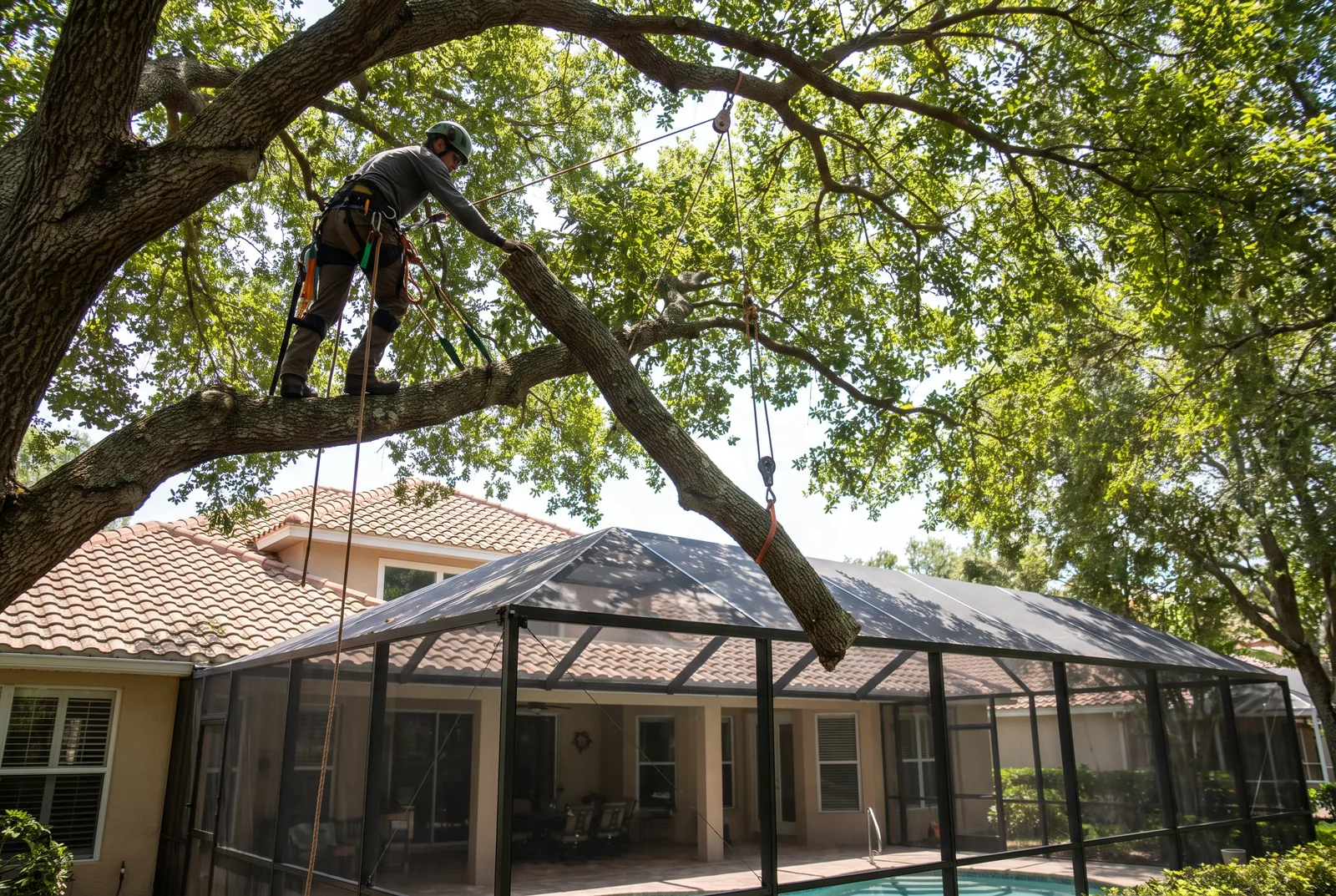
- A big laurel oak or slash pine, 50 to 70 feet, close to your house, pool cage or canal, which we take apart in sections on ropes: $1,600 to $3,600.
- A crane job, whether that's because the tree hangs over your roof, your lot's too tight, or the wood's too rotten for a climber: $2,500 to $6,500.
Want the stump ground out as well? Plan on another $75 to $600.
Price by tree, 2026
| The job | What you'd pay | Examples we see |
|---|---|---|
| Under 25 ft, small tree or palm, easy to reach | $300 – $750 | Crape myrtle, a young pine, a queen palm |
| 25 to 50 ft, with space to fell it | $700 – $1,600 | Pine, magnolia or laurel oak in an open yard |
| 50 to 70 ft, close to buildings | $1,600 – $3,600 | Roped down in sections: oaks hanging over a drive, a pool cage or a seawall |
| Over your house, or just huge | $2,500 – $6,500 | Needs a crane |
| Washingtonia palm, 40 to 60 ft tall | $800 – $2,800 | Costs more when it leans over a roof |
| Grinding out the stump | $75 – $600 | Priced stump by stump, by how wide it is |
| A city permit, if one's called for | Usually not required | In PSL, most yard trees on single-family lots are exempt |
Why two trees of the same height can cost very different amounts
What it'd land on. Here in Port St. Lucie this matters more than anything else. GDC laid the lots out close together, so most of the big oaks we're called to are standing about twenty feet from somebody's house. If we can drop a tree whole, you're looking at around two hours of work. Put that same tree above a roof, a pool enclosure, a fence, your neighbor's driveway or a canal seawall, and it has to come apart in something like fifty pieces lowered on ropes, or get lifted out by crane, and now it's a full day.
The kind of tree, and how healthy it is. A laurel oak is heavy and is often hollow inside, so it takes us longer, with more risk, to climb than a pine of equal height. Nobody can safely climb a dead tree, and that means bringing in the crane. Palms go fast, unless they're tall ones.
How we get to it. Whether our bucket truck can pull up on your driveway and reach the tree, or the crew has to haul every tool and every piece through a side gate to a yard that backs onto a canal, can swing the labor by about half. Trees on a seawall and back yards with a screened cage are where prices climb the most.
Cleanup and the stump. Our prices already cover chipping and hauling it all away, though you'll find some outfits leave those out of the number they give you. The stump always gets its own line, and so does carting off a big trunk that's too thick for the chipper.
When you book. With us, a storm day costs what any other day does. Sending a crew out after hours for an emergency does add a call-out fee, though. And if your removal isn't urgent, booking it for one of the quieter months can sometimes save you a bit.
Reading a quote, ours or anyone else's
Ours spells out which tree it is, how we'll bring it down (felling, rigging or crane), the chipping and hauling, stump grinding if you'd like it, a permit if one applies, and your total. It's good for 30 days, and our certificate of insurance comes along with it. If somebody hands you a business card with a single number scribbled on it, ask them what that number actually covers and whether they carry workers' comp.
Common questions
Two companies quoted me $900 and $2,800 for one tree. Why so far apart?
Most of the time it comes down to how they plan to do it and whether they're insured. The cheap one may be planning to just drop the tree and hope for the best, or may not carry workers' comp, and that matters a lot if a climber gets hurt in your yard. The pricey one might have built in a crane you don't actually need. Ask each of them to walk you through their method and to send you their certificate of insurance.
Do I save anything taking out more than one tree?
You do, usually 15 to 30 percent on each tree, since the crew and gear are already on site. It works the same way when a few neighbors on one street book together.
Will my homeowners policy cover the removal?
Only if the tree has damaged a covered structure, and even then there's usually a limit. Taking down a healthy tree, or a dying one, before anything happens isn't covered. Our insurance guide goes into more detail.
What if I skip the stump?
That keeps $75 to $600 in your pocket. Leaving a stump in a mulch bed is no problem, but in a St. Augustine lawn you'll be mowing around it, and if it's an oak it'll keep sending up sprouts for years.
What does a crane add?
Getting one set up accounts for about $900 to $1,500 of your total. On a big tree over the house, though, it often takes the place of two days of rigging work, so you end up paying the same or less.
Related: Removal service · Crane work · Do you need a permit? · Insurance and your tree